Showing posts with label food. Show all posts

Monday, August 22, 2011

Recipe: Steak Lettuce Wraps

A simple but (absolutely, holy crap) delicious dinner for two on a late summer day: marinated and thinly-sliced grilled steak, rolled up in lettuce leaves with a handful of herbs and other toppings.


Summer_081


Ingredients (serves 2)

1 lb sirloin steak
cherry tomatoes, halved
cucumber, julienned
shallots, thinly sliced
basil
mint
cilantro
soy sauce
1-2 limes
sugar

Procedure

1. Marinate the steak with soy sauce and the juice of about half a lime. The longer the better.

2. Prepare the tomatoes, cucumbers, and fresh herbs.

3. Grill the steak until desired done-ness (I always prefer medium or medium-rare, especially if the meat is of good quality). If you don't have a grill, searing it on very high heat will do.

4. Make some more soy sauce / lime juice dressing, adding a bit of sugar to taste.

5. Thinly slice the steak across the grain. Drizzle the dressing over and let it soak into the meat.

6. Roll up some steak and veggies into a lettuce leaf. Devour.

Sunday, May 29, 2011

Old Plank Farm.

Plymouth, WI. Population 8000, home to the quintessential bread-and-butter American who does his groceries at the Piggly Wiggly Supermarket and his laundry at the local Laundr-o-mat. The town lies in the middle of miles and miles of green pasture and cheese farms.

I’ve been here for a week now, working for a young organic farmer on her 25-acre plot of land. There are 900 egg chickens, 200 meat chickens, 4 goats, a cute border collie named Max, and two kittens that live out in the barn. 3 pigs are due to arrive next week. Out in the fields, few vegetables are ready this early in the season, but small signs of life are beginning to poke out from the dirt – sweet corn, lettuce, strawberries, and newly-planted potatoes. In the greenhouse, currently in seedling cells waiting to be transferred into the soil are kale, chard, tomatoes, cucumbers, kohlrabi, zucchini.

The beginnings of sweet corn.
Farm_584

The eggs are sold at a local coop a short drive away in Sheboygan. 20 people subscribe to the farm’s CSA (community-supported agriculture) program, which means they buy a share of the land and drive out once a week to collect their fresh produce.

Farm_544

Now in its third year, the farm is still in its infancy. The land is still haphazardly divided, the soil is a bit rocky, and there is an irrigation pond that needs to be built. Not much money rolls in yet, many functional structures still need to be constructed, and equipment is borrowed – but there is bounty enough to eat from the earth year-round, and this farmer has a work ethic to rival three men combined. The only thing that seems to frustrate her is not being able to work 24 hours a day.

Greenhouse.
Farm_563

The days start early with routine morning chores.

The goats need to be milked every 12 hours. Momma, the gray one, is a stubborn thing who withholds milk on purpose just out of spite. Lucy, the small brown one, is ever fidgety, always threatening to knock over the milk bowl. If I can manage to get them calmed down and cooperating – and that’s a big if – the pinch-and-squeeze rhythm of milking isn’t as difficult as I’d imagined. The other goats will come by and nibble on my ear, and the cats will try to steal a few licks. After all this, the milk gets filtered for impurities, and we drink it, raw and chilled, with breakfast lunch and dinner.

Farm_549

Twice a day, I’m responsible for feeding and watering the little chicks that are now housed in the brooder for warmth, as they slowly grow into sizable broilers. If they get too hungry, they attack my scoop as I reach in to fill their troughs. A madly chirping, adorable yellow mass.

Brooder where the chicks are housed.
Farm_589

Farm_601

Out on the backside of the field, there are five coops of adult broilers that have to be moved every day. This ensures that they get fresh grass and new bugs, and that they’re never trampling over their own feces.

Same with the egg-laying chickens. They’re housed in wooden triangular frames in a large fenced-in area of land that also has to be shifted every few days. The problem of moving the frames is not a trivial one. Another intern has been working to construct an egg-mobile on wheels, to make things easier.

Ever-curious chickens gathered around to see what I'm doing. Triangular frames in the back, where they lay their eggs.
Farm_575

Construction of the egg-mobile.
Farm_587

Every day, we go out with baskets and collect the day’s fresh eggs that the hens laid in their triangular houses. Then they must be washed one-by-one, inspected for cracks – small cracks we salvage for ourselves, bad cracks we throw to the animals – and then packaged in cartons for sale. Every day, the hens produce at least 50 dozen eggs.

Those “pasture-raised” eggs and chicken you buy at the grocery store? Behind them is a lot of labor, dirty work, and love.

Aside from these daily chores, other tasks vary from day to day. Right now I’m working to paint a rolling vegetable stand that will be used to sell roadside produce. I’ve planted seeds in cells, turned over rows of soil, pulled up thistles and dandelions from the strawberry plot, covered up plants to protect from frost, and helped cover potatoes with moldy hay to help them grow. The two other interns that also live here have been working to construct a chicken-plucker in preparation for when the broilers go to be slaughtered, and also a fenced-in pen to hold the pigs.

The flats where seeds are planted, before being transplanted into the ground.
Farm_567

I have a week left on the farm. There is much more to do and to learn.

Sunday, February 06, 2011

Recipe: Steamed fish and tofu.

It has been quite some time since I've posted a recipe, but my kitchen is busy as always. Despite feeling the onslaught of grad school - classes, teaching, reading papers - I still make sure to eat homemade meals most days of the week.

This dish I made tonight is my mother's recipe, and has always been one of my favorites. It takes the light tastes of fish and tofu, and drizzles it with a bold, spicy sauce. From start to finish, it takes no more than 30 minutes (20 if you're efficient) to get on the table.


Ingredients

microwavable glass or ceramic dish
1 large fillet of tilapia or other white fish (~10 oz)
1 package Japanese-style silken tofu
rice cooking wine
3-4 stalks spring onion, finely chopped
small hot chilis (like serrano), finely chopped
a neutral oil, like canola or vegetable
soy sauce
sesame oil
rice, for serving

Method

1. Thinly slice the fish. Sprinkle with salt and marinate it with rice cooking wine in a bowl.

2. Thinly slice the tofu. Chop onions and chilis.

3. Layer fish and tofu pieces alternately in the microwavable dish. In other words, place pieces of fish-tofu-fish-tofu in a row, and fill up the dish by repeating this way. Place in microwave, and set for 8 minutes. The tofu and fish will steam and cook together.

4. In a small pan, heat the neutral oil, then sautee onions and chillis until soft. Turn off heat. Mix in about half-cup (but I never measure, so use your judgment!) of soy sauce, and a few tablespoons of sesame oil.

5. When tofu and fish are done, drizzle the sauce over. Serve over rice. Goes great with some garlic-sauteed leafy greens.

Thursday, January 27, 2011

A sad goodbye to The Minimalist.

I woke up this morning to a flurry of links on my food blogroll pointing to the final post of Mark Bittman's Minimalist column in the New York Times. It was not a pleasant way to wake up. Even I am surprised by how sentimental I'm getting, as I think back to the effect that this single column has had on my cooking history.

The Minimalist was originally called Bitten, and this I started reading when I first started cooking in Australia. They plopped me in the country, gave me a kitchen, and for guidance, I had two resources: the internet and my mother, and my mother was far away. Before I even knew who Mark Bittman was, even before I could cook much of anything at all, I learned from him how to make things like kielbasa and cabbage, cumin-spiced lentils, and roasted eggplant. His recipes were less like recipes and more like outlines, full of opportunities for variation and personal flair. His videos were witty and unpretentious, and stressed the simplicity of the process. The first thing that I ever learned about cooking was that all you need for a good meal are just a few good ingredients, a basic knowledge of what heat does to those ingredients, and a grasp on how tastes and textures blend together. (And above all else, use garlic liberally.)

No exaggeration, it was this blog alone that taught me, crucially, how to cook, not what to cook. A person can follow a million recipes with success, but still fail to understand why, for example, you drizzle sesame oil last or why you shouldn't crowd the pan when browning or why you do one particular step before another.

Sure, I eventually accumulated a dozen more food blogs that I continue to skim every day, but over the years, Bitten (and then The Minimalist) remained the only blog whose every post I would read faithfully and carefully, and that is because of the way it encouraged me to think about food and cooking in holistic and not just functional ways.

I know it's sappy, but I'm going to miss reading the column like I'd miss a friend. Anxiously awaiting something new from Mr. Bittman.

Wednesday, August 25, 2010

Indiana State Fair.

Last weekend, my friend Alex drove down here to my new abode in Lafayette, Indiana. Since I'm still relatively new to the Midwest (going to school in Chicagoland does not count, in my opinion), we decided to get a feel for its culture by going to the Indiana State Fair down in Indianapolis, about an hour drive from where I live.

Deep-fried foods being a quintessential element of all state fairs, it was a gluttonous day. We started out with a "pepsi burst", which Alex is seen munching on here. Fried dough balls, coated with cinnamon sugar and doused in a pepsi-based syrup. I was hoping more for a fried ball with carbonated pepsi inside which would gush out when chewed. Oh well.


It is difficult to resist the sight and smell of gigantic turkey legs being roasted on a grill. Despite the legs being as big as my face, it was not difficult for us to finish one off, doused in black pepper and hot sauce.


The culinary highlight of the day was the infamous donut burger, which is exactly what it sounds like. A grilled beef patty, with melted cheese, onions and pickles, between two Krispy Kremes. The prospect of clogging my arteries with the thing terrified me until I ate it. It was an interesting blend of sweet and savory, and tasted oddly like a Big Mac. Not something that I'd do every day, but I certainly enjoyed the novelty of it.


And then there was the hot beef sundae, which I had been meaning to try since seeing it at the Tennessee State Fair a few years ago. It was delicious, but not quite as cool as it sounds, being a normal concoction of mashed potatoes over chunks of beef, topped with corn and gravy.


The most hilarious moment of the fair was when we discovered a machine called VibraBody Slim, meant to shake your fat off with varying speeds of vibrations. When you turn it on, the platform on which you stand begins to shake back and forth, and your entire body begins to jiggle - a sight that had me doubled over in laughter for a good ten minutes. Speeds increase all the way up to level 30, at which point my vision blurred and I became quite nauseous, and could feel my brain vibrating within my skull. We revisited the machines at the end of the day, and discovered that 3 out of their 5 display models had been sold. Oh, oh, Indiana.


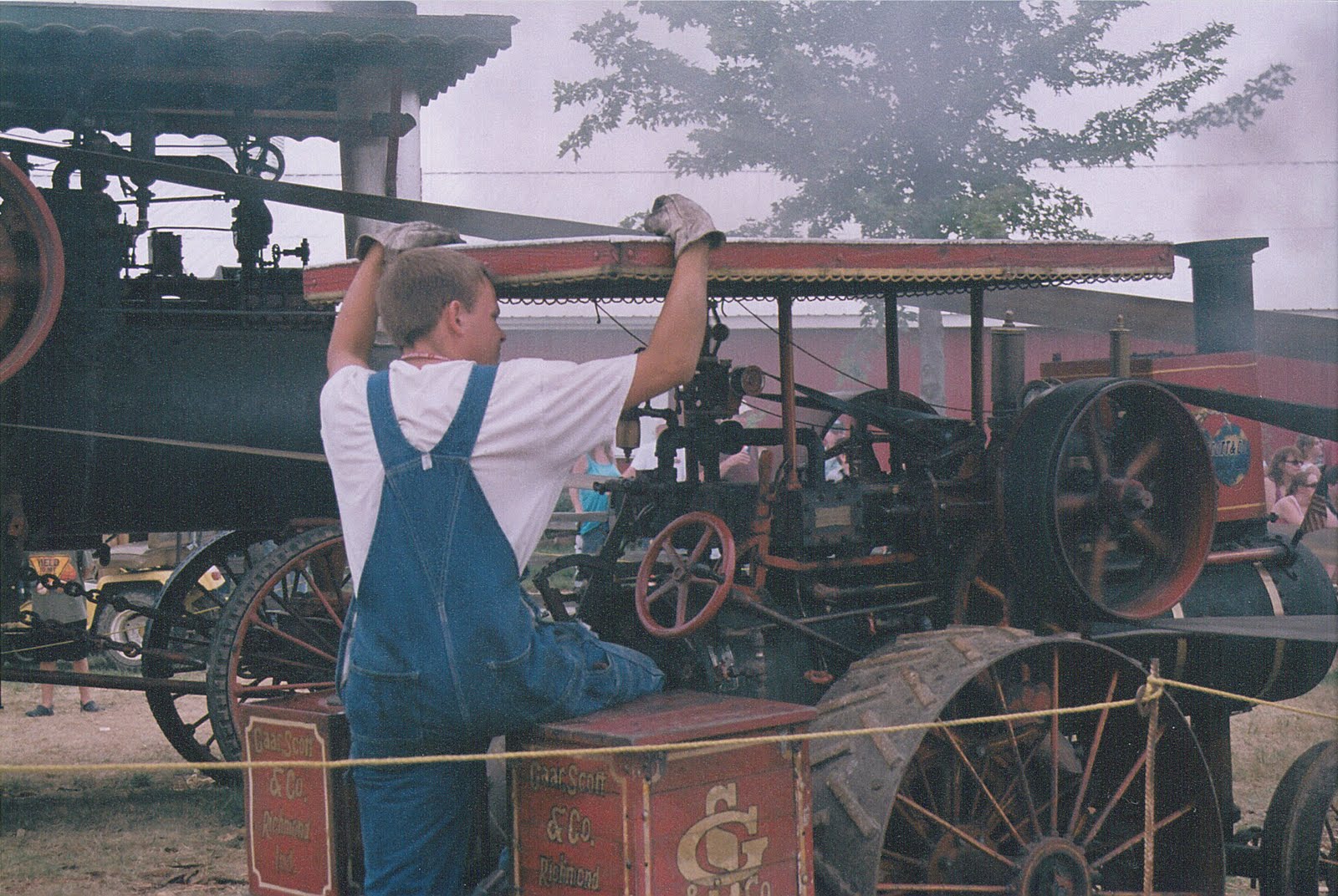
The rest of the time, we just strolled around, enjoying the sight of carnival rides, tractors as big as houses, smaller farm vehicles from the '60s and '70s, hogs, goats, draft horses, blacksmith demonstrations, smoke-emitting wood-chopping machines, and many other things that I find charming about rural America.


This thing cost as much as my parents' house!


A word about these pictures: I no longer own a digital camera, having ruined my previous one with an unfortunate water spill. However, my dad gave me his old Canon EOS Elan II, a 35mm SLR camera made in the late '90s. Having never used a film camera before, it was a challenge to fiddle with settings without being able to immediately see the results, and to be limited to just 36 pictures for the entire day. However, I'm largely happy with how they turned out, and I think the grainy quality almost highlights the rustic feel of the all-American Midwest.

There are some instances when I feel that advanced digital cameras are almost too perfect in how they capture reality, whereas slight imperfections can give an image a quality of dreaminess, which I'm drawn to. I'd really like to use this Canon as a base for learning more about film photography.

End tangent. The weekend was a good one. I'm settling into Indiana just fine.

Thursday, July 29, 2010

Floating on the Li River.

When my alarm went off early in the morning, a storm was raging outside and I went back to sleep, thinking in a haze what a shame it was that my original plans wouldn't work out that day. The plan was to see the two villages of Xingping and Yangdi on foot by hiking the 25 kilometers between them, following the Li River.

A few hours later it was no longer raining, and I started out anyway despite the ominous clouds. However, upon arrival at the starting point of Yangdi, I learned to my dismay that the hiking trail towards Xingping had been closed due to flooding. After a good deal of haggling, I decided to take a bamboo raft and float downstream to my destination instead.


This alternative was a good one. Having spent the last few days simmering in the humidity under a searing sun, it felt to me like the entire earth had cooled with the rain, and that the mountains had grown more lush, more green, now shrouded in white fog.

The peaks were giant men with their heads in the clouds, and I put-putted my way down the river, peering up at them towering over me, my jaw agape.


A few hours later, we reached Xingping. Not quite done soaking in the view yet, I walked through the villages surrounding Xingping for a few more hours.

Lush groves of bamboo.

Later that night, back in Yangshuo for dinner, I revisited the same Sichuan restaurant where I ate the previous night. The owners had clucked over me the night before like two old mothers, sat and talked with me, and had let me order two half-dishes for the price of one, extra spicy, pickled vegetables free. They had made me bitter melon stuffed with minced pork, the sauce loaded with enough Sichuan peppercorns to numb a person’s mouth for days. And now, hungrily, I was back for more.

This time, they invited me to dine with their kitchen staff. With the owners and the cooks, I had a small feast of fried river fish, spicy pig lung in garlic sauce, and raw cucumbers doused with vinegar and chili oil. My favorite dish was the button mushrooms stuffed with minced pork, each piece bite-sized and fiery. It was a memorable meal.

Sunday, July 18, 2010

Hong Kong: Lantau Island.

While Hong Kong proper lies on the hub of Hong Kong Island, the city spreads out over a series of islands and territories, including Kowloon and the New Territories to the north, Lantau Island to the west, and hundreds of smaller outlying islands.

On my second day in the city, Matt and I took the train to Lantau Island, which is suitably removed from the urban rush. Once there, we got on a cable car with panoramic views of the ocean and skyscrapers rising from land. As we neared Lantau Peak, the highest point on the island, however, a thick fog obscured our view entirely, and threatened to thwart our plan to see the crowning attraction of the island: the 35-meter-tall Tian Tan Buddha statue.


As expected, there was not much to see up top, even after climbing the long steps to the statue to get in front of the fog.


Much more interesting, however, was the Tai O fishing village, located on the western edge of the island. We started out perusing the markets, which had all kinds of intriguing goods from the ocean, from tiny dried shrimp to hanging salted squid and medicines made from fish parts.


We spent the next few hours walking along the waterfront through the village, passing houses on stilts, multi-colored boats, fish hung up to dry, and tiny housing complexes made of what looked like tin and framed with aging wood. Picturesque, to say the least.


To top off our day, we had a huge dinner at a seafood restaurant in the village: greens in a broth with dried seafood, scallops with celery, and shrimp with cashews - tender, not at all overcooked, and obviously straight from the sea. To have food from the ocean every day like this would be a dream indeed.